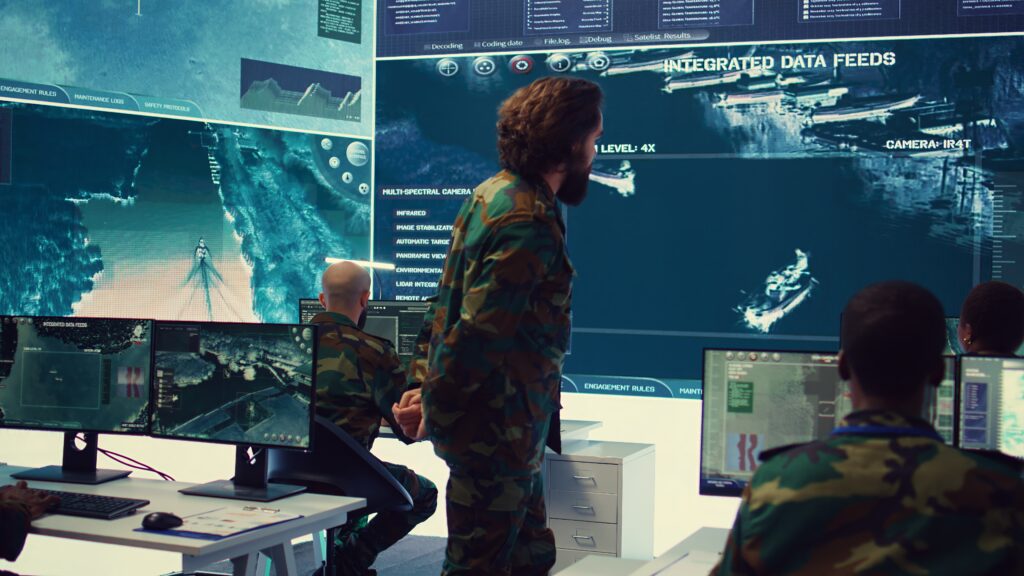
As the US and Israel deployed artificial intelligence systems at unprecedented scale against Iran in early 2026, the world witnessed the first true AI-enabled war—where machines compressed kill chains from hours to seconds, and the future of warfare became terrifyingly clear.
April 25, 2026
On February 28, 2026, when the United States and Israel launched Operation Epic Fury against Iran, they didn’t just deploy conventional military might. They unleashed something far more transformative: artificial intelligence systems operating at what military strategists call “machine speed”—processing intelligence, identifying targets, and generating strike recommendations faster than human cognition can follow.
Within the first 12 hours alone, nearly 900 strikes hammered Iranian targets. By the end of the first day, over 1,000 targets had been hit—twice the firepower of the 2003 “shock and awe” campaign in Iraq, but delivered in a fraction of the time. The architect of this unprecedented tempo wasn’t human genius or superior firepower. It was artificial intelligence.
“What we’re seeing in this current conflict is decisions being handed to machines,” Professor Toby Walsh, an AI expert at the University of New South Wales, told The Daily News Australia. “We’re going to look back and think, this was the critical turning point.”
The Maven Smart System: Silicon Valley Meets the Kill Chain
At the core of the US military’s AI deployment sits a system called Maven Smart System, built by Palantir Technologies and incorporating Claude, the large language model developed by Anthropic. Maven represents the maturation of Project Maven, which began in 2017 as a computer vision tool to scan drone footage but has since evolved into something far more powerful.
Maven consolidates what were previously eight or nine separate intelligence streams—satellite imagery, drone video feeds, signals intelligence, intercepted communications, radar data, and human intelligence reports—into a single digital platform. Machine learning algorithms then process this ocean of data to identify and prioritize potential targets, recommend appropriate weaponry, and even evaluate the legal grounds for a strike.
The system operates with breathtaking speed. What would take a human intelligence staff hours or days to analyze, Maven processes in seconds. During Operation Epic Fury’s opening phase, the AI system helped coordinate strikes against Supreme Leader Ali Khamenei and numerous Iranian military installations with a precision and tempo that would have been impossible using traditional targeting methods.
Brad Cooper, head of US Central Command (CENTCOM), confirmed the transformative role of AI: “Our warfighters are leveraging a variety of advanced AI tools. These systems help us sift through vast amounts of data in seconds so our leaders can cut through the noise and make smarter decisions faster than the enemy can react.”
The operational advantage is staggering. By late 2025, Maven had been deployed to more than 35 military services and combatant commands with over 20,000 active users. The National Geospatial-Intelligence Agency director stated in September 2025 that by June 2026, Maven would begin transmitting “100 percent machine-generated” intelligence to combatant commanders—meaning algorithmic recommendations with minimal human preprocessing.
Israel’s Algorithmic Arsenal: The Gospel and Lavender
While the United States led with Maven, Israel brought its own formidable AI targeting systems to the conflict: The Gospel (Habsora in Hebrew) and Lavender, developed by the elite intelligence Unit 8200.
The Gospel functions as an AI-driven target bank that continuously scans surveillance imagery and intelligence to identify buildings, infrastructure, and equipment linked to hostile organizations. Where a human analyst team might identify 50 viable targets per year, The Gospel can generate up to 100 bombing targets per day—a 700-fold increase in targeting throughput.
Lavender complements this by focusing on individuals rather than locations, using machine learning to identify suspicious persons based on their social connections, communication patterns, and movement profiles. During Israel’s 2023-2024 operations in Gaza, Lavender reportedly identified 37,000 Palestinian men as potential targets for assassination in just six weeks.
A third tool, informally called “Where’s Daddy?”, tracks individuals on kill lists and triggers strike authorization the moment a target enters their private residence—a capability that demonstrates how AI enables surveillance and strike coordination at scales previously unimaginable.
Together, these systems produced what their architects described as a “data-driven targeting factory” capable of generating inexhaustible lists of recommended strikes. In the Iran campaign, this meant Israeli and American forces could maintain relentless operational tempo, striking targets faster than Iranian defenses could adapt.
Machine Speed Warfare: Compressing the Kill Chain
The transformation AI brings to warfare isn’t merely quantitative—more targets struck more quickly. It’s fundamentally qualitative, changing the nature of military decision-making itself.
Traditional targeting follows a sequence called F2T2EA: Find, Fix, Track, Target, Engage, Assess. Each step requires different intelligence disciplines, different analysts, and different communication channels. A satellite detects something suspicious. An imagery analyst confirms what it is. A signals intelligence team cross-references with intercepted communications. A targeting officer assigns it to a weapon system. A commander authorizes the strike. The entire process typically takes 24 to 72 hours—during which the target may move, making the effort worthless.
AI compresses this sequence by performing multiple steps simultaneously. Instead of sequential human analysis, an AI system ingests all available data at once, runs classification algorithms, and produces targeting recommendations in seconds. The find, fix, track, and target steps that took human staff sections hours happen in a single computational cycle.
During US Army testing of AI targeting systems, one demonstration identified, prioritized, and generated firing solutions for 15 separate targets in one hour—a task that would have required 12 to 24 hours using traditional methods with a staff of dozens.
Dr. Jean-Michel Valantin, a strategic studies specialist, noted in the Small War Journal that the scale of strikes on Iran’s first day—over 1,000 targets—was “linked to the massive use of AI by the American and Israeli militaries.”
The Ethical Reckoning: When Machines Make Life-and-Death Decisions
The spectacular military effectiveness of AI-enabled targeting has sparked an equally spectacular ethical controversy, crystallized in the public confrontation between Anthropic and the Pentagon.
In February 2026, the Department of Defense demanded that Anthropic grant unrestricted access to its Claude AI model for “any lawful use.” Anthropic refused, maintaining two “bright red lines”: Claude would not be used for mass surveillance of Americans or to power fully autonomous weapons that kill without human approval.
“Frontier AI systems are simply not reliable enough to power fully autonomous weapons,” declared Dario Amodei, Anthropic’s CEO, in February 2026.
The Pentagon’s response was swift and punishing. Defense Secretary Pete Hegseth designated Anthropic a “supply chain risk”—a label historically reserved for foreign adversaries like Huawei—and President Trump ordered federal agencies to cease using Anthropic’s technology. The Pentagon threatened to invoke the Defense Production Act to compel Anthropic’s cooperation or blacklist the company from government contracting.
“We will not let ANY company dictate the terms regarding how we make operational decisions,” Pentagon spokesperson Sean Parnell wrote on X.
The confrontation raises profound questions about accountability in algorithmic warfare. When an AI system presents a completed firing solution and a human operator has 30 seconds to approve or reject before the target moves, how meaningful is that human oversight? The operator can’t independently verify the AI’s analysis. They can’t personally review the raw intelligence. They’re effectively rubber-stamping a machine’s recommendation under time pressure—a dynamic computer scientists call “automation bias.”
Internal Israeli reviews reported that Lavender operated with approximately 90% accuracy. That sounds impressive until you realize it means roughly 3,700 people were wrongly placed on kill lists during Gaza operations—many of them journalists, human rights activists, or displaced persons whose behavioral patterns were misread as signs of militant activity.
Human oversight was often minimal. The Guardian reported that Israeli operators spent as little as 20 seconds reviewing targets recommended by AI—barely enough time to verify coordinates, much less assess the totality of intelligence behind the recommendation.
The Minab School Strike: When AI Gets It Wrong
The dangers of over-reliance on AI targeting became horrifyingly clear on February 28, when a US Tomahawk missile struck the Shajarah Tayyebeh Elementary School for girls in Minab, Iran, killing more than 165 civilians according to Iranian state media. The school was reportedly on a target list generated with AI assistance, though officials claimed outdated intelligence contributed to the error.
The incident, which occurred in the opening hours of Operation Epic Fury, prompted intense Congressional scrutiny. Lawmakers demanded disclosure of whether and how AI systems were implicated in the tragedy. The UN called it “a grave violation of humanitarian law.”
The strike underscores a critical vulnerability in AI targeting: these systems are trained on datasets that emphasize military targets and combat signatures. The civilian environment—schools, hospitals, aid convoys—often appears absent from training sets or treated as background noise. When visual patterns resemble military signatures (a school compound with security might look like a military installation from above), AI systems can misclassify with deadly consequences.
In one documented case, researchers found that an AI targeting system identified wolves versus dogs not by analyzing the animals themselves, but by detecting snow in the background—a completely irrelevant feature that happened to correlate in training data. Such “spurious correlations” are invisible to human operators reviewing AI outputs, making errors nearly impossible to catch in time.
The Future: Where AI Warfare Is Heading
The Iran conflict represents only the beginning of AI’s integration into warfare. Military strategists across the globe are racing to develop even more advanced autonomous systems.
The Pentagon’s FY2027 budget proposal includes $54.6 billion for the Departmental Autonomous Warfighting Group (DAWG)—a 24,166% increase from 2026—with plans to transform it into a unified combatant command coordinating drone, aircraft, and vessel operations across all warfighting domains.
China is pursuing “intelligentized warfare” through its Military-Civil Fusion strategy, rapidly deploying swarm experimentation and building massive robotics manufacturing capacity. Ukraine scaled its drone production from 2.2 million in 2024 to 4.5 million in 2025, with AI increasingly enabling autonomous navigation and targeting in GPS-denied environments.
Russia, through extensive combat experience in Ukraine and Iran operations, has developed particular expertise in tactical battlefield autonomy under electronic warfare conditions—using AI to navigate when jamming disrupts GPS and communications.
General Dan Caine, Chairman of the Joint Chiefs of Staff, stated bluntly in April 2026 that autonomous weapons will be “a key and essential part of everything we do” in future warfare.
The trajectory is toward increasingly autonomous systems operating at swarm scale. Israel is developing brain-computer interfaces allowing single operators to control multiple drones via neural signals. Defense contractors are working on “one-to-many” systems where one human oversees fleets of 10 or more autonomous platforms simultaneously.
At what point does “human in the loop” become meaningless when that human is supervising 50 AI-generated targeting recommendations per minute, or managing a swarm of 25 autonomous drones attacking different targets across a wide area?
The Governance Gap: Laws Struggling to Keep Pace
International humanitarian law remains clear on core principles: attacks must distinguish between civilians and combatants, civilian harm must not be excessive relative to military advantage, and feasible precautions must be taken to minimize civilian casualties.
Yet governance frameworks lag dangerously behind deployment. No binding international treaty meaningfully constrains major-power autonomous weapons development. In March 2026, 156 nations supported a UN General Assembly resolution expressing concern over autonomous weapons proliferation. The United States, China, Russia, and Israel declined to support it, citing the need to maintain technological advantages.
Current US policy prohibits lethal autonomous systems without senior official approval, but critics argue this is a temporary safeguard that operational tempo could sweep away. The Pentagon’s AI Acceleration Strategy, released in January 2026, emphasizes speed above all—”becoming an AI-first warfighting force across all domains.”
Legal frameworks struggle with fundamental definitional questions. At what degree of autonomy does a weapon system cross the threshold into requiring special oversight? Is a drone that autonomously navigates and then asks human permission to strike functionally different from one that strikes autonomously in its final 500 meters? When AI processes intelligence and generates targeting recommendations that humans approve in seconds, who bears responsibility when errors cause civilian deaths?
Taylor Kate Woodcock, a researcher at the University of Amsterdam who studies AI and international law, argues that “AI is not only changing the way militaries fight wars, but it is also reshaping international law” by altering what is considered “reasonable” decision-making under time pressure.
The Anthropic Principle: Can Ethics Survive the Arms Race?
Anthropic’s stand against unrestricted military use of its AI represents a rare instance of a tech company prioritizing ethical boundaries over lucrative government contracts. But the company’s position may be untenable in the long term.
While Anthropic held firm on its red lines, rival OpenAI agreed to the Pentagon’s terms, as did Google’s Gemini and Elon Musk’s xAI. The message to AI companies is clear: cooperate fully or be excluded from the enormous defense market.
More than 100 OpenAI employees and nearly 900 Google employees signed an open letter protesting their companies’ acceptance of Pentagon terms. In April 2026, Caitlin Kalinowski, OpenAI’s head of robotics, resigned, stating: “AI has an important role in national security. But surveillance of Americans without judicial oversight and lethal autonomy without human authorization are lines that deserved more deliberation than they got.”
Yet the competitive dynamics of great power rivalry make restraint difficult. If American companies impose ethical restrictions while Chinese AI firms do not, the argument goes, the United States risks falling behind in the AI arms race. Jensen Huang, CEO of Nvidia, captured this anxiety in November 2025: “China is nanoseconds behind America in AI. It’s vital that America wins by racing ahead.”
The result is what arms control experts call a “deterrence paradox”: each side accelerates development to avoid being at a disadvantage, but the collective effect increases the risk of catastrophic accidents, escalation spirals, or autonomous systems operating beyond meaningful human control.
Conclusion: The Crossroads of Algorithmic Warfare
The Iran-USA-Israel conflict of 2026 will be remembered as the moment AI moved from the periphery to the center of modern warfare—when machine-speed targeting became the decisive advantage, and the kill chain compressed from days to seconds.
The military effectiveness is undeniable. AI enables target identification, prioritization, and strike coordination at scales and speeds that human analysts simply cannot match. In peer conflicts where every second matters, that advantage could be decisive.
But effectiveness without accountability is not victory—it’s a moral and strategic failure that undermines the laws of war and threatens to make conflicts more frequent, more brutal, and more difficult to control.
The fundamental question facing military AI is not whether these systems work, but whether we can keep them working for us rather than accelerating beyond our ability to supervise, understand, or stop them.
As researchers at Maven, Anthropic, and other AI labs continue pushing the boundaries of what algorithms can do on the battlefield, the question is no longer whether AI will transform warfare—it already has. The question is whether we’ll develop the wisdom, restraint, and international cooperation to ensure that transformation serves humanity rather than consuming it.
The machines are learning to wage war at speeds we cannot match. The challenge of our time is learning to govern them at speeds they cannot escape.
Amit Shrivastava
Leave a Reply